Are you an older adult living at home? • Are you caring for a person with a disability? • Do you need help finding local services in the community?


By Mail: Federal Communications Commission
Consumer and Governmental Affairs Bureau
Consumer Inquiries and Complaints Division
45 L Street NE
Washington, DC 20554

>> Click HERE to link to Federal Trade Commission for Additional Info >>
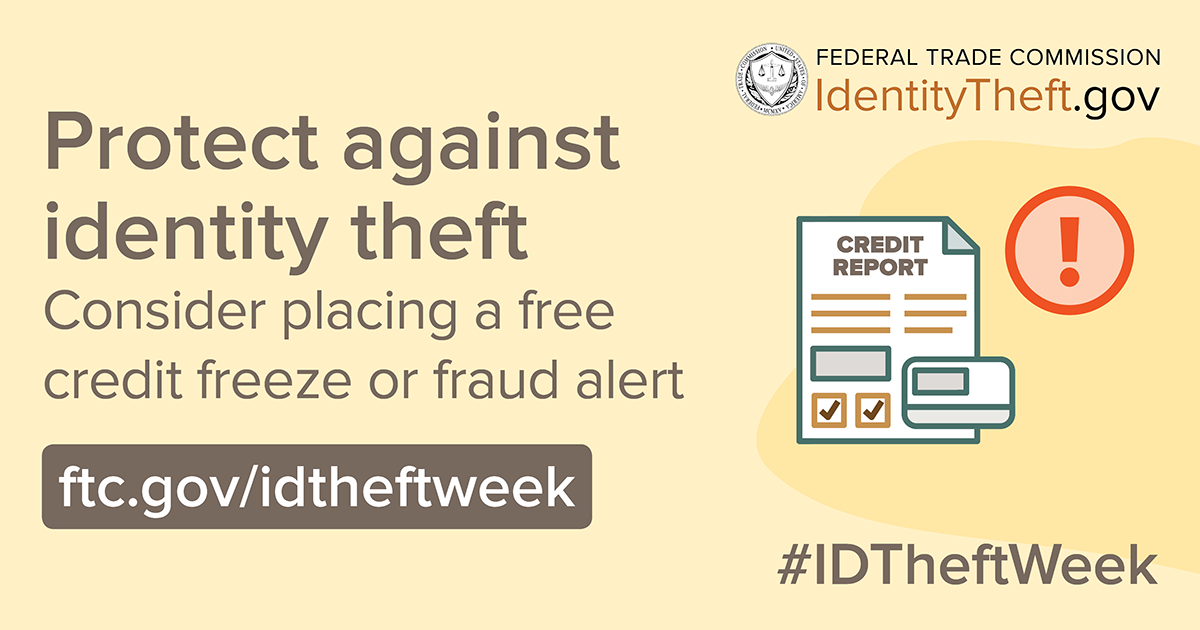 During Identity Theft Awareness Week 2022, we’ve talked about reducing your risk of identity theft. Credit freezes and fraud alerts can help. Both are free and make it harder for identity thieves to open new accounts in your name. One may be right for you.
Credit freezes
A credit freeze is the best way you can protect against an identity thief opening new accounts in your name. When in place, it prevents potential creditors from accessing your credit report. Because creditors usually won’t give you credit if they can’t check your credit report, placing a freeze helps you block identity thieves who might be trying to open accounts in your name.
A freeze also can be helpful if you’ve experienced identity theft or had your information exposed in a data breach. And don’t let the “freeze” part worry you. A credit freeze won’t affect your credit score or your ability to use your existing credit cards, apply for a job, rent an apartment, or buy insurance. If you need to apply for new credit, you can lift the freeze temporarily to let the creditor check your credit. Placing and lifting the freeze is free, but you must contact the national credit bureaus to lift it and put it back in place.
Place a credit freeze by contacting each of the three national credit bureaus, Equifax, Experian, and TransUnion. A freeze lasts until you remove it.
Fraud alerts
A fraud alert doesn’t limit access to your credit report, but tells businesses to check with you before opening a new account in your name. Usually, that means calling you first to make sure the person trying to open a new account is really you.
Place a fraud alert by contacting any one of the three national credit bureaus. That one must notify the other two. A fraud alert lasts one year and you can renew it for free. If you’ve experienced identity theft, you can get an extended fraud alert that lasts for seven years.
Learn more about credit freezes, fraud alerts, and active duty alerts for service members. And, if identity theft happens to you, visit IdentityTheft.gov to report it and get a personal recovery plan.
>>Click HERE to link to Mass.gov for Additional Info>>
Call the Elder Hotline at (888) AG-ELDER or (888) 243-5337. TTY: (617) 727-4765.
The Elder Hotline is open Monday through Friday from 10:00 am to 4:00 pm. The hotline is staffed by senior volunteers\


